Can AI help wheat survive the heat?
As global temperatures rise, the challenge of producing enough food to meet future demand is becoming increasingly urgent.

First published by The University of Adelaide
As global temperatures rise, the challenge of producing enough food to meet future demand is becoming increasingly urgent. Wheat, one of the world’s most important staple crops, is particularly vulnerable to heat stress. Yields must increase by an estimated 2 to 3 per cent each year to keep pace with population growth (Stock et al. 2025), yet climate-induced extremes are making this goal harder to reach.
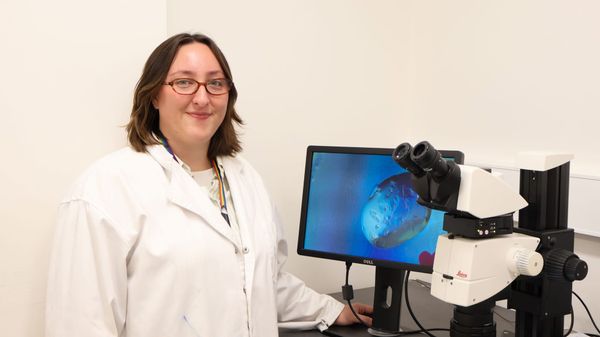
At the Australian Institute for Machine Learning (AIML), engineers are applying artificial intelligence (AI) to identify heat-tolerant wheat varieties quickly, reliably, and at scale.
In a collaboration with The Australian National University (ANU) and the Adelaide University node of the AAGI - Analytics for the Australian Grain Industry (AAGI-AU), AIML has developed advanced machine learning models to predict biological traits linked to heat tolerance in wheat. The model development was led by AIML Machine Learning Engineer Aaron Peter Poruthoor who set out to develop machine learning models capable of extracting important biological insights.
“AI-driven approaches like this can be scaled to accelerate genetic selection across multiple crop species and environments,” Poruthoor said. “By integrating hyperspectral data, genomics, and environmental variables, AI models can help identify heat-tolerant and high-yield varieties more efficiently. This will enable large-scale, non-invasive screening of crops in the field, supporting climate-resilient breeding programs and more sustainable global food production.”
Poruthoor’s efforts resulted in clear performance gains over existing approaches. “[Our machine learning models were] able to outperform [previous models] by 10%,” said Poruthoor.
The collaboration was initiated by Professor Robert Bob Furbank from the ANU Centre of Excellence for Translational Photosynthesis, whose team approached AIML in 2024 to help develop more powerful machine learning methods capable of identifying heat-tolerant wheat traits.
“Finding sources of heat tolerant germplasm for breeding requires the development of high throughput screening tools applicable to the field,” said Professor Furbank. “The major activity underpinning grains breeding is phenotyping, which is expensive and laborious.”
At the core of the project was a rich dataset collected by ANU using an automated robotic system operating in the field. This system captures how a wheat plant’s leaves reflect and utilise light for photosynthesis, revealing how well a plant can perform under heat stress. This metric is known as hyperspectral leaf reflectance.
“Aaron’s group began by developing new approaches to deriving photosynthetic performance from leaf reflectance spectra, a key trait which is heat sensitivity, beginning with our previously published methods as a benchmark,” Professor Furbank explained.
“Significant improvements were made to the predictive power of the existing algorithms using Aaron’s approaches to data processing prior to model building.”
For this project, AAGI-AU Project Lead Associate Professor Julian Taylor and his team worked closely with AIML and ANU on experimental design and genetic analysis of heat tolerance traits. AAGI-AU is based at Adelaide University’s Biometry Hub and has collaborated closely with AIML since 2023.
“The grains industry is keen to move towards automated approaches of comparative experimentation and on-farm monitoring of crops,” said Associate Professor Taylor.
“Dr Olena Kravchuk , Dr Beata Sznajder, and [I] worked closely with the teams to … ensure the design and sampling was fit for purpose. This ensured the traits that were collected from these lab experiments were robust. These traits were then used by AIML to link the hyperspectral wavelengths to the tolerance traits.”
An example of a tolerance trait analysed was how efficiently wheat plants produce gases under heat stress.
“When we shine light across multiple wavelengths onto the leaf surface and measure the reflected spectra, this enables us to infer how much carbon dioxide or oxygen the plant is producing,” Poruthoor explained.
“Machine learning plays a key role here. By analysing hyperspectral wavelength data collected from plant leaves, the models can identify which wheat varieties exhibit high heat tolerance.
“These varieties can then be used to develop new, more heat-resilient wheat strains.”
In addition to a notable increase in performance, the collaboration illustrates how AI can transform crop assessment and breeding under climate pressure.
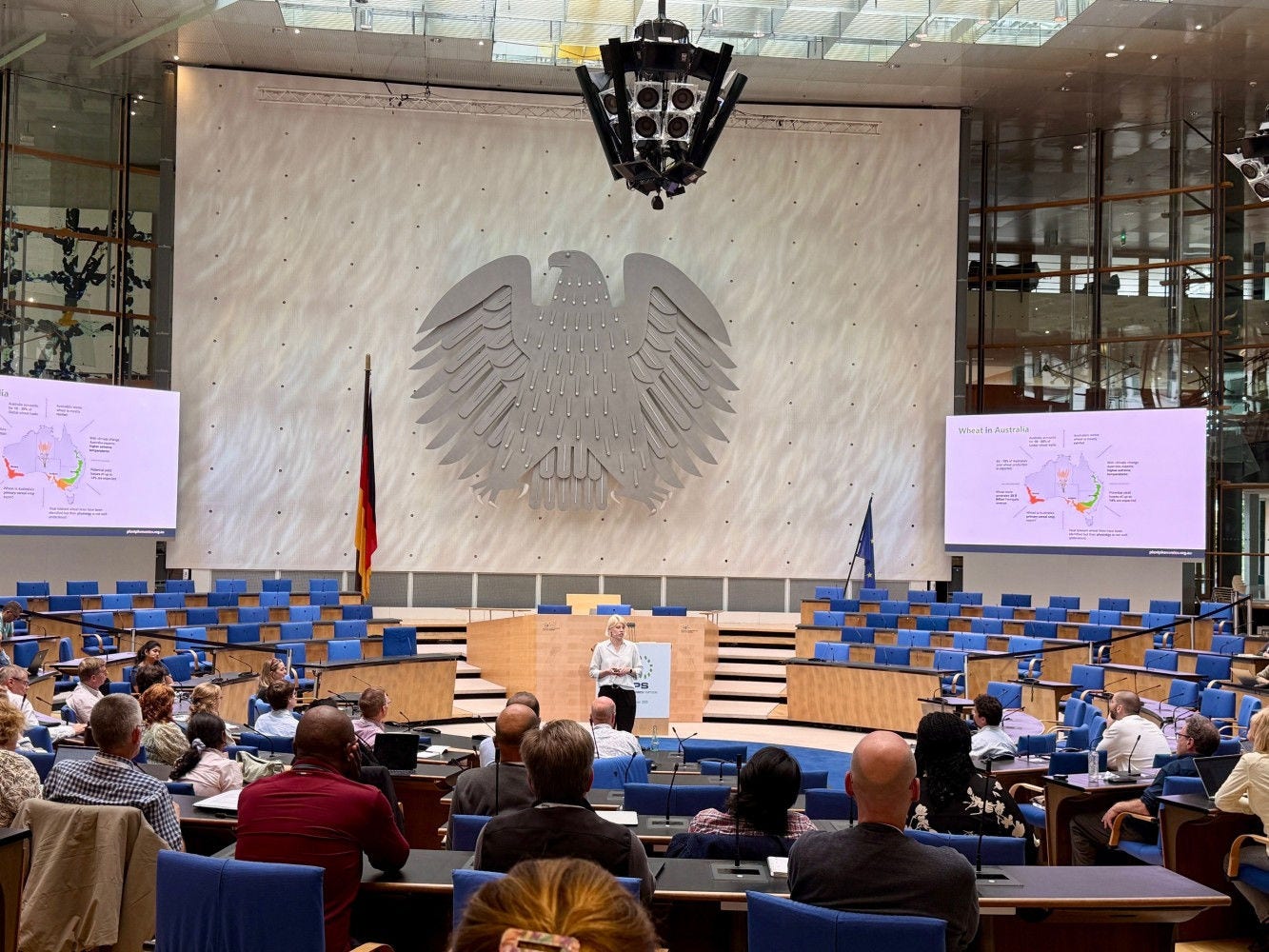
After completing the research, the collaboration’s findings were compiled into a study, titled ‘Phenotyping wheat varieties for heat tolerance – a case study from down under,’ The study was presented by lead author ANU researcher Dr Frederike Stock, PhD at the European Plant Phenomics Conference (EPPS) in September 2025, signalling growing international interest in scalable, AI-enabled approaches to crop resilience.
For collaborators at ANU and AAGI-AU, the project demonstrates how advanced analytics and machine learning can turn complex physiological measurements into practical tools for breeders. For AIML, it highlights the Institute’s role in translating cutting-edge machine learning into real-world impact, helping address one of agriculture’s most pressing challenges in a warming world.
Written by Dr Juan Miguel Balbin, PhD, AIML Digital Content Officer
Originally posted on 3 February 2026 by Dr Miguel Balbin.