National Walk for Truth reaches Parliament House
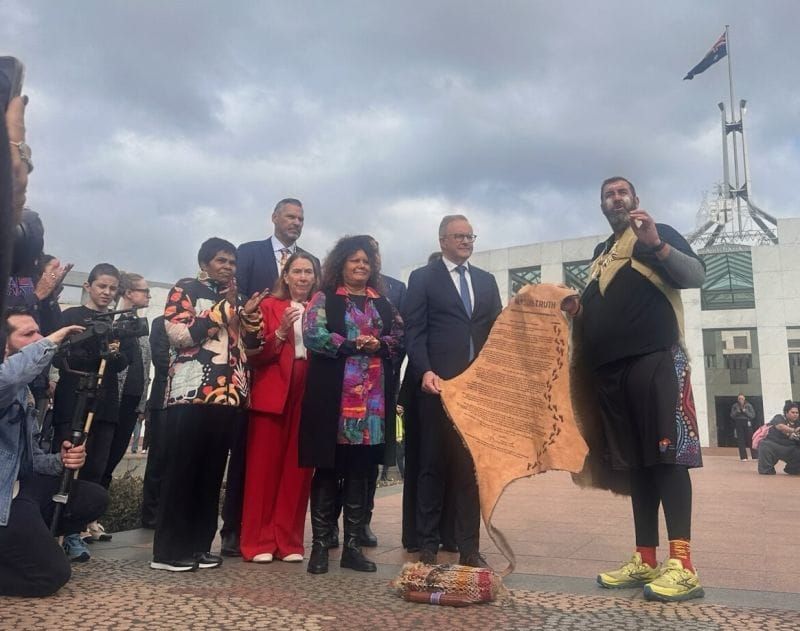
The National Walk for Truth finished today on the steps of Parliament House on Ngambri and Ngunnawal Country, marking the completion of an almost 900 kilometre journey from Naarm (Melbourne) to Canberra.
First published by The University of Melbourne
The National Walk for Truth finished today on the steps of Parliament House on Ngambri and Ngunnawal Country, marking the completion of an almost 900 kilometre journey from Naarm (Melbourne) to Canberra.
Led by Kerrupmara/Gunditjmara and Boandik man Travis Lovett, Executive Director of the University of Melbourne’s Centre for Truth-telling and Dialogue, the Walk brought together people across Australia to listen, learn and engage in a shared process of truth-telling.
“We stand at Parliament with truths that were never meant to survive,” Mr Lovett said. “Their survival demands action from the Prime Minister, not words.
“This is the moment for national leadership. Not symbolic leadership, real leadership that listens, learns and legislates for truth.
“We walked 900km to show what commitment looks like. Now the country must continue to walk the next steps together, side by side.”
The National Walk for Truth builds on the momentum of the 2025 Victorian Walk for Truth and Mr Lovett’s work as Deputy Chair and Commissioner of the Yoorrook Justice Commission, Australia’s first formal truth-telling process.
Professor Barry Judd, Deputy Vice-Chancellor (Indigenous) at the University of Melbourne, said the walk highlighted the need for national leadership to truth-telling.
“The National Walk for Truth has strengthened understanding of why this work matters,” Professor Judd said.
“As it reaches Parliament House, it underscores the need for a coordinated, national approach to truth-telling, led by First Peoples and shaped by their voices and experiences.
“The walk also highlights the importance of evidence-based research in informing national conversations about Australia’s past and present, and the essential role that universities play in contributing to public life.”
The University of Melbourne will continue to support truth-telling through the work of its Centre for Truth-telling and Dialogue and through ongoing engagement with First Peoples and communities across the country, as part of its broader commitment to recognising the historical and ongoing impacts of colonisation on First Peoples.
Speech given by Professor Barry Judd, Deputy Vice-Chancellor (Indigenous) at the University of Melbourne delivered at Reconciliation Place, before walking to Parliament House:
Good morning,
I acknowledge the Ngunnawal and Ngambri peoples, on whose unceded lands we gather today, and I pay my respects to their Elders past, present and future.
We come together on this final day of the National Walk for Truth—an act of endurance, reflection, and purpose. As Travis and Renata complete this journey today, we are reminded that this walk has never been only about distance. It has always been about something deeper: a walk towards truth, towards recognition, and towards a more honest national story.
There is something powerful about walking—step by step, day by day. It asks patience. It asks commitment. And it asks us to stay with something, even when it is difficult. That is what truth asks of us as well.
We meet at a moment in our national life that is both challenging and consequential. These are times in which populism, myth and misinformation can shape our public conversations. And in such times, it is easy to retreat—to emphasise difference, to harden positions, to deepen division.
But this walk stands for something else. It reminds us that, regardless of whether we are Indigenous or non-Indigenous Australians, we share a common responsibility—to seek truth, to listen carefully, and to find the ground that binds us together.
And the truth is this: contemporary Australia is shaped by three undeniable foundations.
First, it is built on the deep and enduring inheritance of Ancient Australia—on more than 65,000 years of continuous cultural practice, knowledge, and connection to Country. Second, it is shaped by British institutions and traditions introduced from 1788. And third, since the end of the Second World War, it has become a profoundly multicultural society—enriched by people, cultures and stories from across the world.
These truths are not in competition—but they are not equal in their place.
Because our task as a nation is to accept all three—and to especially recognise and accept the first. The truth of Ancient Australia is foundational. It is not simply one strand of the story—it is the ground on which everything else rests. And if we are serious about truth, then this is where we must begin.
In 1993, Prime Minister Paul Keating told us that what this country needed was a simple act of recognition. It was a moment of clarity—of moral leadership that spoke honestly about our history and asked Australians to do better. It is hard to say that we have seen that same level of sustained leadership since.
So, as this final leg of the National Walk for Truth is completed today, we mark not just the end of a journey—but a moment of choice. Prime Minister Albanese today is your opportunity to demonstrate that same kind of leadership. To deliver on the promise to implement the Uluru Statement from the Heart in full. Because this is what leadership looks like—not stepping away from difficult truths but stepping towards them. Not allowing division to define us, but helping us find common ground.
If we are to heal as a nation, we must tell the truth about our past—fully and honestly. And in doing so, we can begin to build shared stories of origin—stories that all Australians can recognise, can stand within, and can embrace.
So let this final step of the walk not be an ending, but a beginning.
A beginning of deeper recognition.
A beginning of renewed leadership.
A beginning of a more honest Australia.
Because this moment asks something of all of us—not just to walk for truth, but to stand for it, to speak for it, and to act on it. We know the truth of this country—what remains to be seen is whether we have the moral courage to act on it.
Thank you.
Speech given by Travis Lovett, Executive Director of the Centre for Truth-telling and Dialogue at the University of Melbourne delivered arriving at Parliament House:
Before anything else, I acknowledge the Traditional Owners of this place, the Ngunnawal and Ngambri peoples, and pay my deep respects to Elders past and present.
We gather here on Country that has always had law, language, ceremony, memory and story.
Long before this city became the seat of Parliament, long before decisions were made in buildings of stone and glass, this place was held in the care of First Peoples.
It was known, sung, walked, taught and loved.
Today, as this National Walk of Truth arrives in Canberra, we remember that truth does not begin at the doors of Parliament.
It begins with Country.
It begins with the old people.
It begins with the Nations who have kept speaking, kept remembering, kept carrying what this country has too often refused to hear.
So I pay respect to the Ngunnawal and Ngambri people, to their sovereignty, their survival, there resistance and their continuing care for this place.
And I acknowledge all First Peoples who have walked, gathered, listened and stood beside this journey.
May we be worthy of the truth that has been carried here.
I have arrived here to be with you today at the end of a long journey, more than 900 kilometres walked in the hope that it will lead to a new beginning.
I have come here, to the cradle of the nation’s democracy, in the hope that what I bring with me, and what I must tell you, may spark something inside our collective conscience, a belief that we can do better by adding to the story of this nation.
Not through tropes that tell us what we want to hear, not with carefully cultivated stories of myth and legend, used by some to paint our collective story in their own image.
No.
We the people of the First Nations of this diverse land mass, choose to add TRUTH to the story of this place. TRUTH.
And today, we bring that truth here with a simple and serious request:
that this nation establish a national truth-telling process, built in genuine partnership with First Peoples, strong enough to listen, brave enough to remember and honest enough to help this country heal.
Our people have always walked for justice. We walked when William Barak and the people of Coranderrk carried their petitions and their dignity through the machinery of a colony that wanted them silent.
We walked in the great land rights marches, when our people took to the streets and made the question of land impossible for this nation to ignore.
We walked off Cummeragunja, across the river and away from cruelty, not only in protest, but in an act of survival and self-determination.
We walked with Michael Long, from Melbourne to Canberra, asking this country to look again at itself, to confront racism, to listen with more than its ears.
And now this walk joins that long line of movement and memory, each step carrying the same ancient demand: justice, dignity, truth.
This walk began on the steps of the old colonial parliament in Naarm, on Wurundjeri Woi-wurrung Country, and carried truth across more than 900 kilometres of road, river and memory.
It moved through Taungurung Country, through Yorta Yorta Country, across Wiradjuri and Wiradyuri Country, and into Ngunnawal and Ngambri Country here in Canberra.
Along the way it moved through Wallan and Seymour, through Nagambie and Shepparton, through Benalla, Wangaratta and Wodonga, then across the Murray river rendered as a line of border on a map, but a river still teeming with spirit, still carrying the lifeblood it gives us all.
Swimming across it, we saw Albury, then marched on to Wagga Wagga, Gundagai and Yass; places of dust and water, scar trees and story, where Country still speaks beneath the sound of traffic, where memory sits in the bends of rivers and along the old roads.
But this was not empty Country and it was never silent Country.
Beneath every town name, beneath every fence line, beneath every paddock, bridge and roadside verge, there are older names, older wounds, older cries.
There are places where our people were hunted and driven, where camps were broken,
where blood entered the soil and the rivers kept moving because rivers must.
There are places where reprisal followed resistance, where survival itself was treated as defiance, where the first truths of this nation were buried under settlement, then roads, then monuments, then forgetting.
And still, Country remembers. The trees remember.
The water remembers. The old people remember.
It remembers Broken River and the Faithfull Massacre at Benalla, and the reprisals that followed along the Ovens and through the north-east.
It remembers the horror carried in names like Murdering Island and Gum Creek Lagoon,
where Wiradjuri blood entered the soil and the rivers kept moving because rivers must.
And it remembers something this nation has too often refused to hold in full: that our people were the victims of the largest massacres ever committed on this land, massacres not at the edge of the Australian story,
but at its very centre, written into the soil beneath towns, roads, farms and rivers.
Truth has always been present here, not as an idea,
but as a beating heart beneath the land, waiting for this nation to become still enough, brave enough, human enough to listen.
Step by step, I was joined by the young and old, some weak in frame, but strong in spirit.
Joined by some that would run all the way here if they could and by others eager to me-ander in the moment,
knowing or not knowing that every step they took pushed me forward.
That’s what I want us all to understand what has really arrived here today. Not just one man at the end of a long road, but a man carrying a message etched by many Nations, many hands, many hearts.
It has been welcomed by Elders, walked beside by families, supported by communities, and held by people who still believe this country can be braver than its silence.
The truth has walked all this way. Now it stands at the doors of Parliament.
And with it stand all those who could not make the road themselves, the old people, the children, the families, the communities, the ancestors, all those whose truth has travelled farther than any one body ever could.
This walk is an act of love, an act of kindness in a less kind world.
It is a refusal to surrender to the noise and cruelty of the moment, to the powerful forces that fan division, turn neighbour against neighbour and ask us to see one another as threats instead of kin.
In a time when fear is organised, when lies travel faster than care, when too many people in power mistake hardness for strength, this walk offers something different.
It offers tenderness. It offers courage. It offers the open hand, even after hurt. It says that truth is not a weapon, but a way home.
It says that even after everything our people have carried, we are still prepared to walk toward this country, not away from it, and ask it to become more honest, more generous, more human.
We are at a moment, that if we stand back and look, the soul of the nation is being decided.
Will we be open to hard truths and the healing it brings; or are we to become insular, are we to turn away from the vividness of the world around us and hunker down into our little burrows and then call those holes in the ground the world?
And that is why truth-telling cannot be left to governments alone, or to the slow machinery of institutions that too often arrive late to the suffering of our people.
Truth has always moved first through the bodies of those who carried it;
through the Elders who remembered when the records lied, through the families who kept speaking when the nation turned away,
through communities who understood that silence was never peace,
only the sound power makes when it gets its way.
To tell the truth in this country has always required courage.
Not the loud courage of conquest or domination, but the quieter, harder courage of memory, of survival, of standing before the country and saying: this happened, we are still here, and you cannot build a future by burying the past.
We are not a passive people. We don’t let history wash over us, we have taken to the streets to resist what many thought was inevitable.
We have pushed back when history itself needed more than revision, it requires rewriting, so we have rewritten it based on what was known all along and through the lived experience of those that more than bore witness to it; they gave their blood, their nervous systems, their entire being to it all.
We know truth-telling is possible because we have already seen it begin.
Did hearing the truth of what happened in the place now known as Victoria hurt anyone?
No it didn’t.
Would a national truth telling process hurt anyone?
Of course not.
What we have achieved in what is now known as Victoria, can act as an exemplar for the rest of the country.
An example the nation should and could follow.
Not only did people from all backgrounds contribute to Yoorrook, the Wemba Wemba word for truth, by contributing and to listening,
we learnt how to run the commission, the first of its type here.
We learnt a lot of lessons about what worked and what wasn’t as effective when working with people to tell their truths.
So many lessons, lessons that could be implemented in a national truth-telling process.
It’s not about recriminations, it’s not about guilt, that is not our concern.
Truth-telling is not something First Peoples need alone. It is something the whole country needs, because no people can be free inside a story that is not true.
Let’s be very clear.
Everything that has been achieved for the betterment of our people has been done by us, for us.
We don’t come here humbly, but we do come here full of humility.
We stand here proudly demanding that this nation come meet us in this moment, to do better than it has been doing.
To come with us because we know that the solutions we have for our people can be applied right across this country, to improve the lot of so many.
We are leaders and we choose to lead.
Some people have asked why walk, why now?
The assumption that clouds this land is that the referendum on the voice put an end to the First Nations’ question.
That our role in the life of this country and the bloodlines of our democracy were decided on when the “no” vote came in.
Prime Minister, almost four years ago to the day, on the night the Australian people placed their faith in you to show us a new way, you spoke about the possibility of a kinder, fairer, braver country.
You spoke to something many people still long for, a nation that does not leave people behind, a nation prepared to listen, a nation mature enough to face itself.
Since then, we have lived through the referendum, and through the pain that followed it.
For First Peoples, that campaign opened wounds that have not healed.
It asked our communities to place our history, our grief, our dignity and our hope before the country, and when the vote was over, too many people expected us to simply carry that hurt quietly and move on.
But there is unfinished business here, Prime Minister. Not only political business, moral business.
National business.
A truth-telling process would not reopen those wounds, it would finally begin to tend to them.
It would give this country a chance to start a different conversation, one not built on fear or slogans or the smallness of division, but on listening, honesty and care. At a time when unity is becoming rarer and rarer, when powerful forces ask us to retreat into suspicion and call that safety, truth-telling offers us another path.
It offers Australia the chance to turn a page, not by forgetting what has happened, but by finally having the courage to know it together.
To walk on, under one sky, as wonderfully diverse as all the stars, but firmly part of this beautiful land that we all call home.
We need to remember, too, that truth does not only live in documents or speeches or parliamentary reports.
It lives in our old people. It lives in the ancestors who were taken from Country and held in institutions across the world.
It lives in the sacred objects, the belongings, the cultural inheritance of our people, removed from their rightful places and kept behind glass, in storerooms, in museums, far from the communities who have never stopped calling them home.
When we speak of truth, we speak of their return.
We speak of bringing ancestors back to Country, bringing sacred objects back into the care of the people, restoring what was taken, and acknowledging that healing cannot be complete while our old people and our cultural treasures remain in exile. Truth-telling must make a way for return, for repair, and for the dignity of coming home.
So today, we ask all Australians to come with us.
Not only those who already know this story.
Not only those who have walked beside us from the beginning.
We ask every person who loves this country, every person who wants it to be braver than its fear, kinder than its politics, and larger than its old silences, to join us in truth-telling.
Come and listen. Come and learn. Come and stand in the hard places with us.
Come and help build a country where our children do not inherit denial, where our Elders are heard while they are still here to speak,
where our ancestors are brought home, where our sacred objects are returned, and where the truth is no longer carried only by those who have already carried too much.
Prime Minister, political leaders, this is the moment that has come to meet you.
This walk has reached the steps of Parliament, but it must not be allowed to end at the stone and glass of this place.
Let this be where the country turns its face toward the truth.
Let this be where the long delay ends, where the old silences are no longer polished into comfort,
where another generation is not asked to carry what this one was too afraid to confront.
Establish a national truth-telling process,
not as charity, not as gesture, but as courage made real.
Give this nation the chance to know itself in full light, to tend to what has been broken, and to walk on, not as strangers fenced in by fear, but as one people beneath one wide sky, diverse as the stars, and held always by this beautiful land we all call home.
I have walked my part of the road. Now I ask this country to walk the next part with us.
Thank you.